
UV Light 265 nm
Maximum Germicidal Effect
Through DNA Absorption
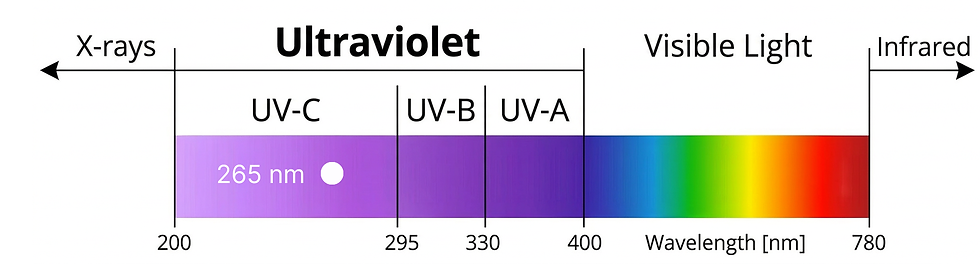
Radiation in the range of 265 nm lies very close to the absorption maximum of nucleic acids. DNA and RNA absorb UV-C radiation particularly strongly in the range of approximately 260–265 nm, causing structural damage in the genetic molecules of microorganisms. These damages prevent DNA replication and reliably inactivate bacteria, viruses, and other microorganisms.
As a result, 265 nm achieves a very high germicidal efficiency per applied radiation dose and is among the most effective wavelengths for physical disinfection without chemicals.
Z-FLEX LED-MODULES
Simplified handling for luminaire manufacturers

The wavelength of deep UV typically lies in the range of approximately 200–280 nm (UV-C). A wavelength of 265 nm is particularly effective, as it coincides with the absorption maximum of DNA/RNA.
In this range, UV light causes:
-
Damage to DNA/RNA
-
Disruption of replication
If the wavelength lies outside this optimal range (e.g., >300 nm), the inactivation effect decreases significantly.
The optical output power of the LED determines how much UV energy is emitted.
-
Measured in milliwatts (mW) or as irradiance (mW/cm²) on a surface
-
Higher power produces greater irradiance and faster inactivation of bacteria, viruses, or spores
The actual effectiveness therefore depends on the wavelength, the LED’s power, and the factor of time.
Case Study
UV-C LED systems provide an effective way to additionally disinfect high-traffic spaces such as medical practices alongside conventional sterilization methods. Using a simulation, it is demonstrated how four linear high-power modules reach surfaces in a typical treatment room and what role room geometry, furniture, and irradiation times play.
Discover how targeted UV-C irradiation between appointments or overnight can contribute to improved hygienic safety.


TYPICAL APPLICATION FIELD
Surface and Packaging Disinfection
In the food, pharmaceutical, and medical technology industries, UV-C is used to disinfect surfaces quickly and without chemicals.
Typical applications:
• Sterilization of packaging films
• Disinfection of conveyor belts
• Disinfection of filling systems
• Treatment of medical devices
• Decontamination of laboratory work surfaces
The high efficiency of 265 nm enables short irradiation times and integration directly into high-throughput production lines. This is particularly relevant in industries with strict regulatory requirements, such as those governed by food and drug authorities or the European Medicines Agency.

TYPICAL APPLICATION FIELD
Air Disinfection
In HVAC systems, UV-C radiation can reduce microorganisms in the air or on components such as cooling coils and filters.
Typical application areas:
• Hospitals and cleanrooms
• Food industry production facilities
• Office buildings and public institutions
• Laboratories and research facilities
• Ventilation, heating, and air-conditioning systems
Integration into ventilation or air-conditioning systems enables:
• Continuous reduction of airborne microorganisms
• Prevention of biofilm growth on heat exchangers
• Improved air quality
• Reduced maintenance of ventilation systems
Thanks to the high efficiency of 265 nm, such systems can be designed compactly and operated with high energy efficiency.

TYPICAL APPLICATION FIELD
Semiconductor and Electronics Manufacturing
The production of microelectronics requires extremely clean environments. UV-C disinfection helps prevent microbiological contamination.
Key application areas:
• Ultra Pure Water systems (UPW)
• Cleanroom air systems
• Disinfection of process pipelines
• Sterilization of tools and components
In semiconductor manufacturing, even minimal biological contamination can affect yield. UV-C systems operating at 265 nm therefore contribute to the stability of highly sensitive manufacturing processes, such as those used by companies like TSMC or Intel.

TYPICAL APPLICATION FIELD
Water and Wastewater Treatment
UV disinfection using LEDs with wavelengths around 265 nm is used worldwide for the microbiological treatment of water. Due to strong DNA absorption, high inactivation rates can be achieved even at relatively low UV doses.
Typical applications:
• Drinking water disinfection in municipal plants
• Industrial process water treatment
• Ultra Pure Water (UPW) for high-tech production
• Ballast water treatment in shipping
• Wastewater disinfection before discharge into natural waters
Advantages:
• No chemical residues
• No change in taste or odor
• Immediate effect
• Low maintenance requirements
Especially with modern UV systems optimized for emission around 265 nm, the required UV dose can be reduced and energy efficiency improved.
Advantages of 265 nm UV-C LEDs
UV LED luminaire VIOLET
Professional UV-C special light with 265 nm wavelength
The VIOLET series offers powerful UV-C LED technology for professional applications - with the wavelength 265 n in four sizes.
It features a robust, anodised aluminium profile with excellent heat dissipation, special LEDiL optics made of UV-resistant material and control LEDs for safe operation at 30 V constant voltage. It is supplied ready for connection with a 10 m supply cable.

CONTACT

Enquire about your project!
Do not hesitate to contact our LED module expert.
Daniel Görike – Key Account Manager –
Tel. +49 7471 96014 – 73
E-Mail dg@leds.de
CONTACT

Enquire about your project!
Do not hesitate to contact our LED module expert.
Paul Sparenborg – Sales Manager –
Tel. +49 7471 96014 – 77
E-Mail ps@leds.de